

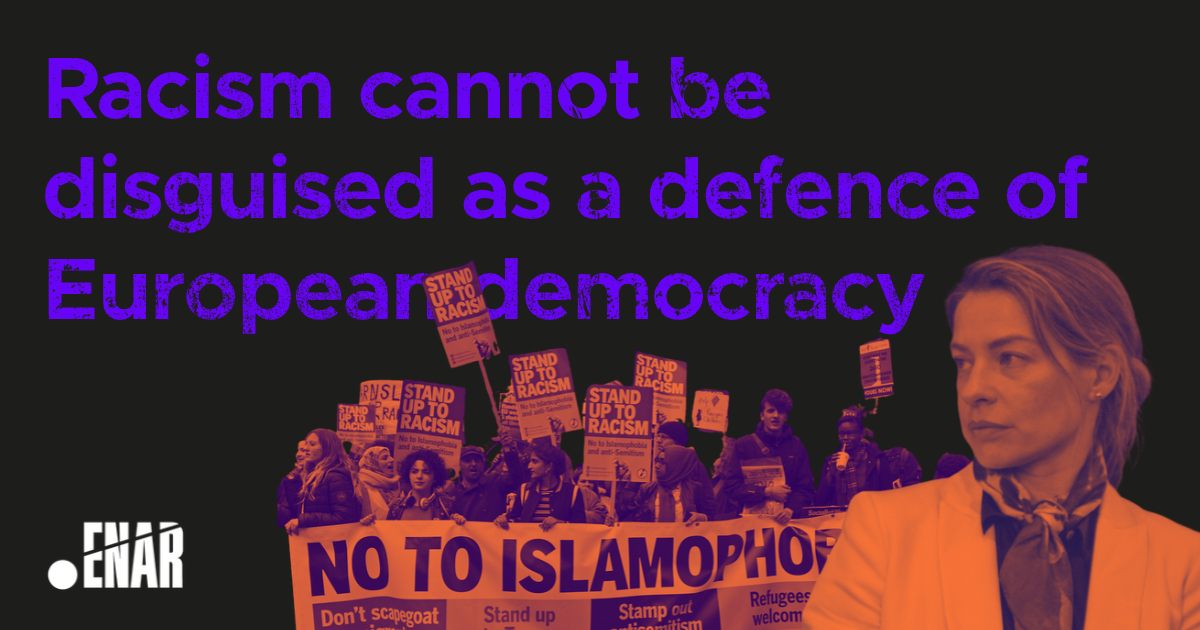
In response to MEP Céline Imart: Racism cannot be disguised as a defence of European democracy
Brussels, Belgium – 18/11/2026
MEP Céline Imart, the initiator of the European Parliament’s resolution on so-called “Islamist entryism”, has responded to our criticism of the resolution by accusing ENAR of intimidation.
Her reaction reflects a much broader and deeply troubling trend within the European Parliament: the normalisation of racism including Islamophobia under the guise of defending European democracy, and the increasing attempts to delegitimise civil society organisations that challenge discrimination.
Let us set the record straight.
1. Defending European democracy by taking lessons from authoritarian regimes? What a joke!
MEP Imart has justified her racist resolution by citing warnings she received from countries such as Egypt, Jordan and the United Arab Emirates.
There is something profoundly grotesque about claiming to defend European democracy by taking advice from authoritarian regimes that imprison political opponents, repress civil society and systematically violate fundamental rights on how to defend democracy.
These are governments with a long history of treating political opposition and dissent as threats to national security. Yet they are now being invoked to justify suspicion towards Muslim communities and civil society organisations in Europe.
The irony is staggering: those claiming to protect Europe from foreign interference are themselves not only invoking the narratives of authoritarian governments to justify restrictions on fundamental freedoms within Europe but also themselves influenced by foreign regimes.
What a joke!
2. This resolution does target Muslims across Europe. The text speaks for itself.
Despite claims that the resolution targets only a political ideology, its actual provisions tell a very different story.
Among its many deeply troubling provisions, the resolution explicitly supports banning the niqab and burqa in public spaces, identifies criticism of Israel as a potential indicator of ideological radicalisation, and proposes treating the production of CSO reports and the use of anti-discrimination frameworks as possible signs of Islamist infiltration.
What exactly do Muslim women’s religious clothing, political dissent and the defence of fundamental rights have to do with radicalisation?
This resolution turns religious practices, legitimate political expression and human rights advocacy into grounds for suspicion, surveillance and exclusion.
We are not the ones manufacturing hatred. The resolution itself does precisely that, seeking to institutionalise discrimination under the guise of defending European values.
3. Criminalising anti-racist organisations and silencing criticism is not democracy.
The baseless allegations attempting to associate ENAR and our member organisation FEMYSO with the Muslim Brotherhood are nothing more than political smears. We refuse to dignify these fabricated accusations by treating them as established facts requiring a defence. Repeating falsehoods in parliamentary resolutions and on social media does not turn them into facts. Nor does parliamentary endorsement transform political smears into truth.
Denouncing racism including Islamophobia is not intimidation. It is the exercise of a fundamental democratic freedom. But perhaps that distinction is difficult to grasp when lessons on protecting democracy are sought from authoritarian regimes that imprison precisely those who dare to criticise them.
The growing attempts to discredit, intimidate and exclude civil society organisations working against racism should concern everyone who believes in democracy, regardless of their political affiliations.
We will not stand by and allow European democracy to be undermined by the normalisation of racism, the stigmatisation of Muslims and the delegitimisation of those who challenge discrimination. We will continue to organise, advocate, educate and mobilise people across Europe against racism.
Europe knows all too well that fascism and authoritarianism do not always arrive by force. They can also advance through parliamentary majorities, legislative procedures and the gradual dismantling of fundamental rights under the pretext of protecting society.
History should have taught us that democratic procedures are no guarantee against profoundly undemocratic politics.
Democracy is not about silencing those who denounce injustice. And securing a parliamentary majority does not magically transform a discriminatory resolution into a defence of fundamental rights.